1986 Interview: Survivor Chad Martin Describes Abuse by Jerry Sidell
Original publication: May 28, 1986. Original headline: “Chad Martin speaks out about the awful experience of being molested.” Byline: Sam Heys.
Content note: This archival report discusses child sexual abuse and its effects.
Historical document: terminology and safety guidance reflect the newspaper’s reporting at the time and may not reflect current best practices. Line-end hyphenation has been normalized for readability.
From the archive
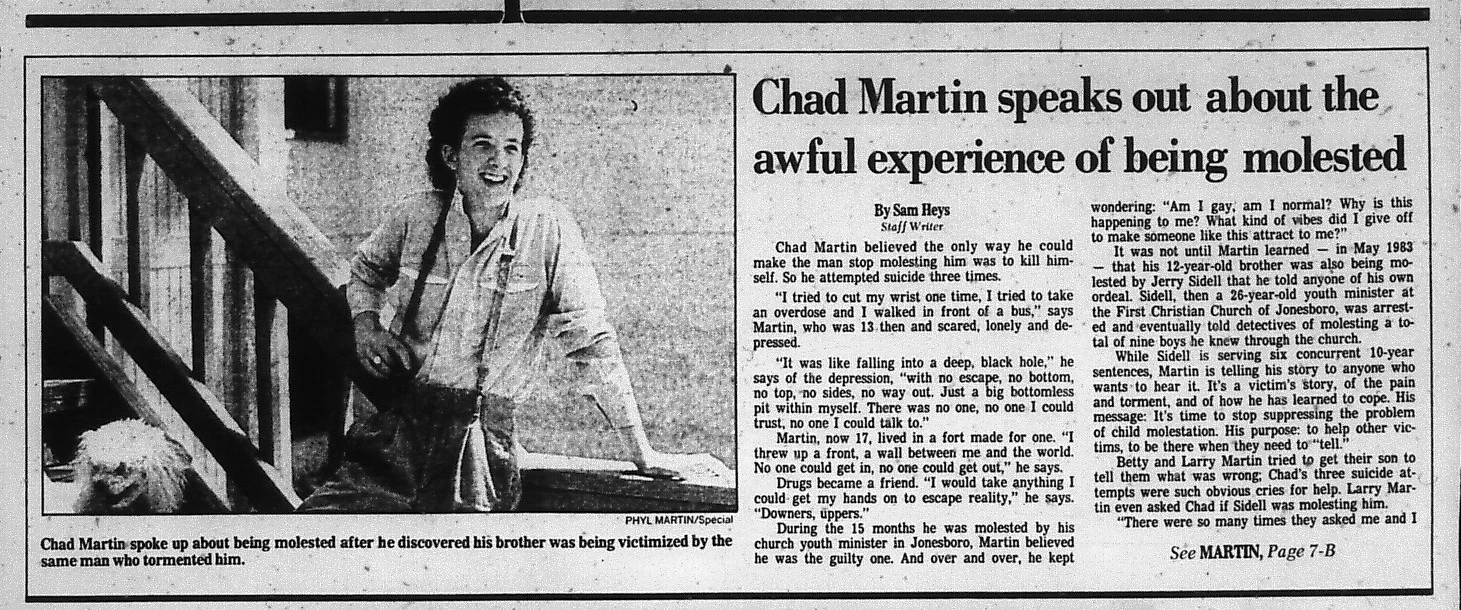
Original newspaper headline: Chad Martin speaks out about the awful experience of being molested
Chad Martin believed the only way he could make the man stop molesting him was to kill himself. So he attempted suicide three times.
“I tried to cut my wrist one time, I tried to take an overdose and I walked in front of a bus,” says Martin, who was 13 then and scared, lonely and depressed.
“It was like falling into a deep, black hole,” he says of the depression, “with no escape, no bottom, no top, no sides, no way out. Just a big bottomless pit within myself. There was no one, no one I could trust, no one I could talk to.”
Martin, now 17, lived in a fort made for one. “I threw up a front, a wall between me and the world. No one could get in, no one could get out,” he says.
Drugs became a friend. “I would take anything I could get my hands on to escape reality,” he says. “Downers, uppers.”
During the 15 months he was molested by his church youth minister in Jonesboro, Martin believed he was the guilty one. And over and over, he kept wondering: “Am I gay, am I normal? Why is this happening to me? What kind of vibes did I give off to make someone like this attract to me?”
It was not until Martin learned — in May 1983 — that his 12-year-old brother was also being molested by Jerry Sidell that he told anyone of his own ordeal. Sidell, then a 26-year-old youth minister at the First Christian Church of Jonesboro, was arrested and eventually told detectives of molesting a total of nine boys he knew through the church.
While Sidell is serving six concurrent 10-year sentences, Martin is telling his story to anyone who wants to hear it. It’s a victim’s story, of the pain and torment, and of how he has learned to cope. His message: It’s time to stop suppressing the problem of child molestation. His purpose: to help other victims, to be there when they need to “tell.”
Betty and Larry Martin tried to get their son to tell them what was wrong; Chad’s three suicide attempts were such obvious cries for help. Larry Martin even asked Chad if Sidell was molesting him.
“There were so many times they asked me and I just wanted to belt out and tell them,” says Martin. “But there was just something inside of me saying, ‘No, you can’t. They won’t understand.’”
Martin says fear kept him silent. He believes that fear was built on “brainwashing threats” made by Sidell. “The fact that if I told, everybody would think I was gay, he would lose his job, he would lose his family, and that’s devastating for someone like me. I wouldn’t want to be responsible for anything like that happening to anybody,” says Martin.
“Plus, he had a pistol. He never verbally threatened me with it, but he made it very evident that it was there.”
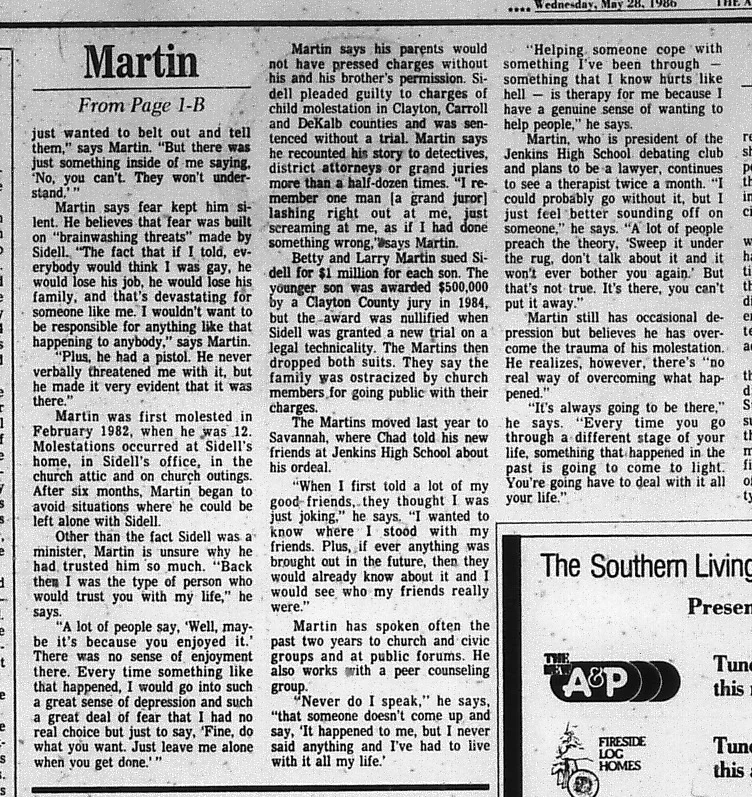
Martin was first molested in February 1982, when he was 12. Molestations occurred at Sidell’s home, in Sidell’s office, in the church attic and on church outings. After six months, Martin began to avoid situations where he could be left alone with Sidell.
Other than the fact Sidell was a minister, Martin is unsure why he had trusted him so much. “Back then I was the type of person who would trust you with my life,” he says.
“A lot of people say, ‘Well, maybe it’s because you enjoyed it.’ There was no sense of enjoyment there. Every time something like that happened, I would go into such a great sense of depression and such a great deal of fear that I had no real choice but just to say, ‘Fine, do what you want. Just leave me alone when you get done.’”
Martin says his parents would not have pressed charges without his and his brother’s permission. Sidell pleaded guilty to charges of child molestation in Clayton, Carroll and DeKalb counties and was sentenced without a trial. Martin says he recounted his story to detectives, district attorneys or grand juries more than a half-dozen times. “I remember one man [a grand juror] lashing right out at me, just screaming at me, as if I had done something wrong,” says Martin.
Betty and Larry Martin sued Sidell for $1 million for each son. The younger son was awarded $500,000 by a Clayton County jury in 1984, but the award was nullified when Sidell was granted a new trial on a legal technicality. The Martins then dropped both suits. They say the family was ostracized by church members for going public with their charges.
The Martins moved last year to Savannah, where Chad told his new friends at Jenkins High School about his ordeal.
“When I first told a lot of my good friends, they thought I was just joking,” he says. “I wanted to know where I stood with my friends. Plus, if ever anything was brought out in the future, then they would already know about it and I would see who my friends really were.”
Martin has spoken often the past two years to church and civic groups and at public forums. He also works with a peer counseling group.
“Never do I speak,” he says, “that someone doesn’t come up and say, ‘It happened to me, but I never said anything and I’ve had to live with it all my life.’”
“Helping someone cope with something I’ve been through — something that I know hurts like hell — is therapy for me because I have a genuine sense of wanting to help people,” he says.
Martin, who is president of the Jenkins High School debating club and plans to be a lawyer, continues to see a therapist twice a month. “I could probably go without it, but I just feel better sounding off on someone,” he says. “A lot of people preach the theory, ‘Sweep it under the rug, don’t talk about it and it won’t ever bother you again.’ But that’s not true. It’s there, you can’t put it away.”
Martin still has occasional depression but believes he has overcome the trauma of his molestation. He realizes, however, there’s “no real way of overcoming what happened.”
“It’s always going to be there,” he says. “Every time you go through a different stage of your life, something that happened in the past is going to come to light. You’re going have to deal with it all your life.”
Source attribution: Historic Atlanta newspaper clipping from the Atlanta Journal-Constitution archives (edition to verify), May 28, 1986. Article by Sam Heys. Transcribed from historical microfilm scans supplied for research. Original headline and byline retained. Newspaper text and imagery belong to their respective rights holders.