1986 Newspaper Report on Child Safety Cites Jerry Sidell Conviction
Original publication: October 8, 1986. Original headline: “Parents’ worry: Who can be trusted with the children?” Byline: Jane O. Hansen.
Content note: This archival report discusses child sexual abuse and its effects.
Archival note: This article mentions Jerry Sidell in a list of other reported cases; it is not an article dedicated solely to Sidell.
Historical document: terminology and safety guidance reflect the newspaper’s reporting at the time and may not reflect current best practices. Line-end hyphenation has been normalized for readability.
From the archive
Original newspaper headline: Parents’ worry: Who can be trusted with the children?
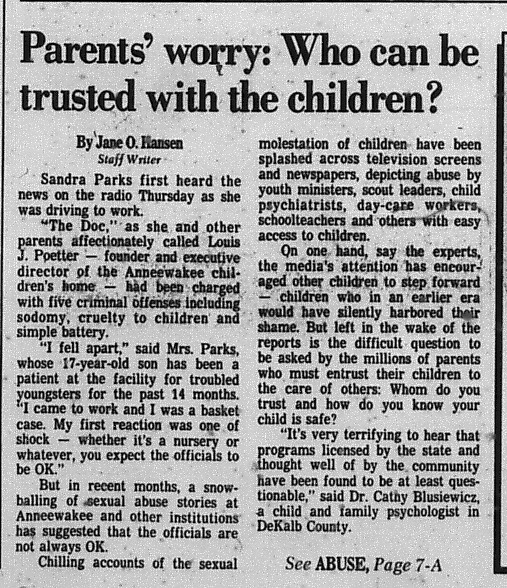
Sandra Parks first heard the news on the radio Thursday as she was driving to work.
“The Doc,” as she and other parents affectionately called Louis J. Poetter — founder and executive director of the Anneewakee children’s home — had been charged with five criminal offenses including sodomy, cruelty to children and simple battery.
“I fell apart,” said Mrs. Parks, whose 17-year-old son has been a patient at the facility for troubled youngsters for the past 14 months. “I came to work and I was a basket case. My first reaction was one of shock — whether it’s a nursery or whatever, you expect the officials to be OK.”
But in recent months, a snowballing of sexual abuse stories at Anneewakee and other institutions has suggested that the officials are not always OK.
Chilling accounts of the sexual molestation of children have been splashed across television screens and newspapers, depicting abuse by youth ministers, scout leaders, child psychiatrists, day-care workers, schoolteachers and others with easy access to children.
On one hand, say the experts, the media’s attention has encouraged other children to step forward — children who in an earlier era would have silently harbored their shame. But left in the wake of the reports is the difficult question to be asked by the millions of parents who must entrust their children to the care of others: Whom do you trust and how do you know your child is safe?
“It’s very terrifying to hear that programs licensed by the state and thought well of by the community have been found to be at least questionable,” said Dr. Cathy Blusiewicz, a child and family psychologist in DeKalb County.
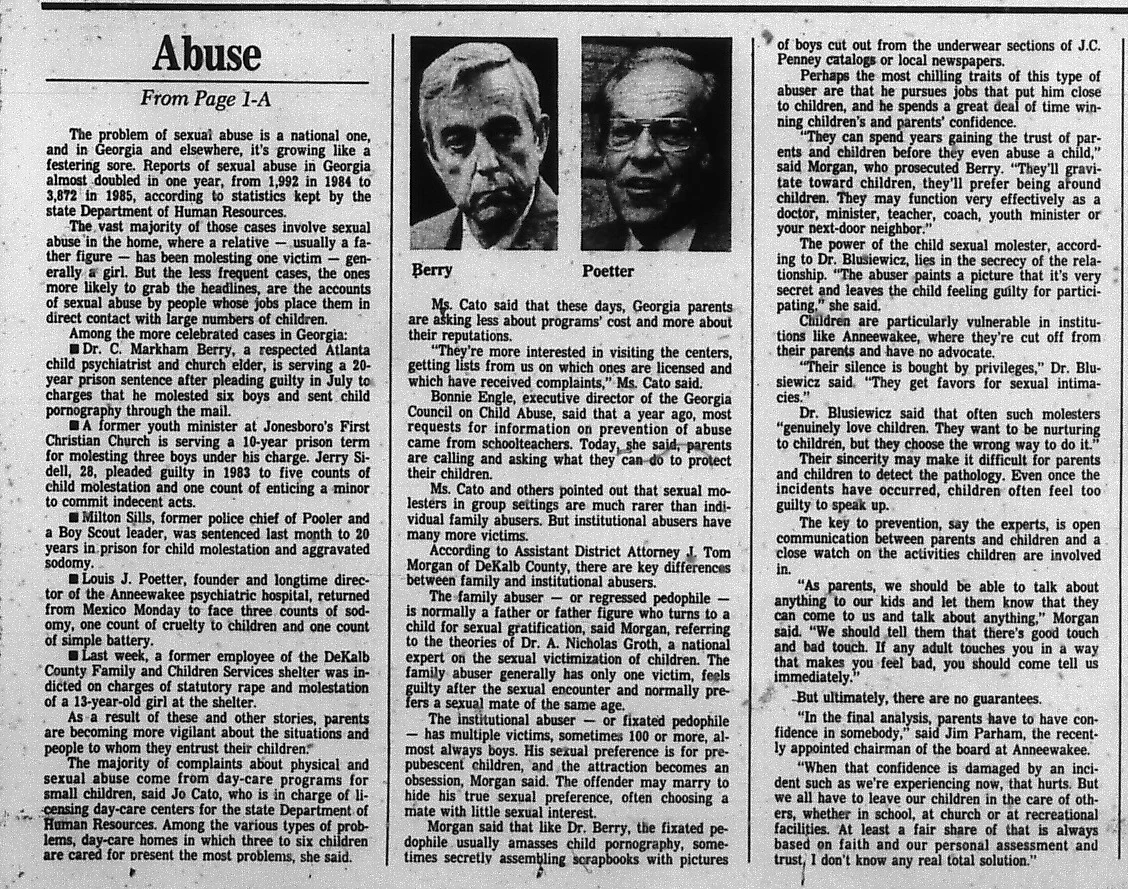
The problem of sexual abuse is a national one, and in Georgia and elsewhere, it’s growing like a festering sore. Reports of sexual abuse in Georgia almost doubled in one year, from 1,992 in 1984 to 3,872 in 1985, according to statistics kept by the state Department of Human Resources.
The vast majority of those cases involve sexual abuse in the home, where a relative — usually a father figure — has been molesting one victim — generally a girl. But the less frequent cases, the ones more likely to grab the headlines, are the accounts of sexual abuse by people whose jobs place them in direct contact with large numbers of children.
Among the more celebrated cases in Georgia:
• Dr. C. Markham Berry, a respected Atlanta child psychiatrist and church elder, is serving a 20-year prison sentence after pleading guilty in July to charges that he molested six boys and sent child pornography through the mail.
• A former youth minister at Jonesboro’s First Christian Church is serving a 10-year prison term for molesting three boys under his charge. Jerry Sidell, 28, pleaded guilty in 1983 to five counts of child molestation and one count of enticing a minor to commit indecent acts.
• Milton Sills, former police chief of Pooler and a Boy Scout leader, was sentenced last month to 20 years in prison for child molestation and aggravated sodomy.
• Louis J. Poetter, founder and longtime director of the Anneewakee psychiatric hospital, returned from Mexico Monday to face three counts of sodomy, one count of cruelty to children and one count of simple battery.
• Last week, a former employee of the DeKalb County Family and Children Services shelter was indicted on charges of statutory rape and molestation of a 13-year-old girl at the shelter.
As a result of these and other stories, parents are becoming more vigilant about the situations and people to whom they entrust their children.
The majority of complaints about physical and sexual abuse come from day-care programs for small children, said Jo Cato, who is in charge of licensing day-care centers for the state Department of Human Resources. Among the various types of problems, day-care homes in which three to six children are cared for present the most problems, she said.
Ms. Cato said that these days, Georgia parents are asking less about programs’ cost and more about their reputations.
“They’re more interested in visiting the centers, getting lists from us on which ones are licensed and which have received complaints,” Ms. Cato said.
Bonnie Engle, executive director of the Georgia Council on Child Abuse, said that a year ago, most requests for information on prevention of abuse came from schoolteachers. Today, she said, parents are calling and asking what they can do to protect their children.
Ms. Cato and others pointed out that sexual molesters in group settings are much rarer than individual family abusers. But institutional abusers have many more victims.
According to Assistant District Attorney J. Tom Morgan of DeKalb County, there are key differences between family and institutional abusers.
The family abuser — or regressed pedophile — is normally a father or father figure who turns to a child for sexual gratification, said Morgan, referring to the theories of Dr. A. Nicholas Groth, a national expert on the sexual victimization of children. The family abuser generally has only one victim, feels guilty after the sexual encounter and normally prefers a sexual mate of the same age.
The institutional abuser — or fixated pedophile — has multiple victims, sometimes 100 or more, almost always boys. His sexual preference is for prepubescent children, and the attraction becomes an obsession, Morgan said. The offender may marry to hide his true sexual preference, often choosing a mate with little sexual interest.
Morgan said that like Dr. Berry, the fixated pedophile usually amasses child pornography, sometimes secretly assembling scrapbooks with pictures of boys cut out from the underwear sections of J.C. Penney catalogs or local newspapers.
Perhaps the most chilling traits of this type of abuser are that he pursues jobs that put him close to children, and he spends a great deal of time winning children’s and parents’ confidence.
“They can spend years gaining the trust of parents and children before they even abuse a child,” said Morgan, who prosecuted Berry. “They’ll gravitate toward children, they’ll prefer being around children. They may function very effectively as a doctor, minister, teacher, coach, youth minister or your next-door neighbor.”
The power of the child sexual molester, according to Dr. Blusiewicz, lies in the secrecy of the relationship. “The abuser paints a picture that it’s very secret and leaves the child feeling guilty for participating,” she said.
Children are particularly vulnerable in institutions like Anneewakee, where they’re cut off from their parents and have no advocate.
“Their silence is bought by privileges,” Dr. Blusiewicz said. “They get favors for sexual intimacies.”
Dr. Blusiewicz said that often such molesters “genuinely love children. They want to be nurturing to children, but they choose the wrong way to do it.”
Their sincerity may make it difficult for parents and children to detect the pathology. Even once the incidents have occurred, children often feel too guilty to speak up.
The key to prevention, say the experts, is open communication between parents and children and a close watch on the activities children are involved in.
“As parents, we should be able to talk about anything to our kids and let them know that they can come to us and talk about anything,” Morgan said. “We should tell them that there’s good touch and bad touch. If any adult touches you in a way that makes you feel bad, you should come tell us immediately.”
But ultimately, there are no guarantees.
“In the final analysis, parents have to have confidence in somebody,” said Jim Parham, the recently appointed chairman of the board at Anneewakee.
“When that confidence is damaged by an incident such as we’re experiencing now, that hurts. But we all have to leave our children in the care of others, whether in school, at church or at recreational facilities. At least a fair share of that is always based on faith and our personal assessment and trust. I don’t know any real total solution.”
Source attribution: Historic Atlanta newspaper clipping from the Atlanta Journal-Constitution archives (edition to verify), October 8, 1986. Article by Jane O. Hansen. Transcribed from historical microfilm scans supplied for research. Original headline and byline retained. Newspaper text and imagery belong to their respective rights holders.